Jutsu Studio
In short
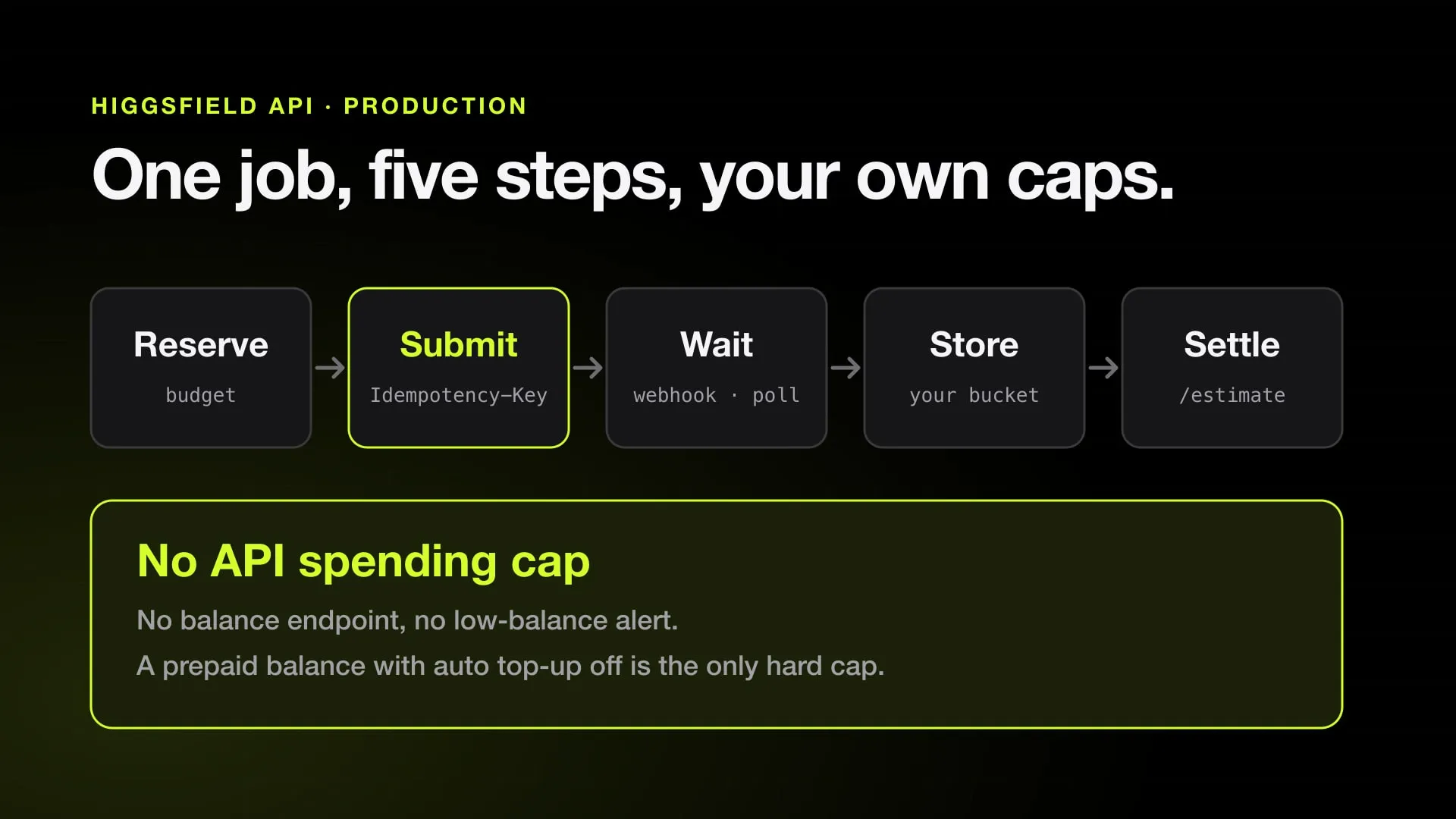
- The Higgsfield API has no spending limit, no balance endpoint and no low-balance alert, as of October 2026; a prepaid balance with auto top-up off is the only hard cap.
- Webhooks use the Standard Webhooks scheme, HMAC-SHA256 over id, timestamp and body, but deliveries are unsigned until the secret is first revealed in the Higgsfield Console.
- An Idempotency-Key on a submission makes a retry return the original request with no new charge; the same key with different parameters returns 422.
- At the concurrency limit the live API answered 400 "Maximum number of concurrent requests (N) has been reached", not the documented 429 account_queue_full.
- Failed, NSFW-flagged, canceled and timed-out requests are not charged.
Calling the Higgsfield API once is easy: a key, a POST, a request ID. Running it behind a paid product is where the details matter, and some of them are not where you would look. The API has no spending cap, so you build your own. Webhooks are unsigned until you reveal a secret in the Console. A retry without an Idempotency-Key can pay twice. And at the concurrency limit the live API answers with a different error than the docs describe.
Below is what we found in Higgsfield’s documentation and in calls to the real API in October 2026, marked live where the two differ. The full notes, with a source link for each fact, are in docs/higgsfield-api.md of Higgsfield Gateway. For what the API is and how it differs from Higgsfield’s MCP and CLI, start with Higgsfield API vs MCP vs CLI.
Keys and requests
- Auth: the header
Authorization: Key KEY_ID:KEY_SECRET. Keys have no scopes, so a key bills the whole account; to rotate, create a new key, deploy it, then delete the old one. - Never ship the key in a browser or mobile app. Higgsfield’s Terms of Use forbid it, and a leaked key spends your balance.
- Submit returns
request_id,status_url,cancel_urlandexpires_after: 604800. Every response carries anX-Correlation-ID; keep it with the job for support. - The API rejects
null(live). Leave optional fields out instead. Seedance 2.5 schemas also forbid unknown keys and empty arrays. - Seedance 2.5 has no
autoaspect ratio. It defaults to 16:9, so a vertical source rebuilt withoutaspect_ratio: "9:16"comes back horizontal.
Statuses, polling and what is charged
A request moves through queued and in_progress to one of four terminal states: completed, failed, nsfw or canceled. Accept cancelled too, and treat an unknown status as still running (live).
- Polling:
GET /requests/{id}/status. Start at 2 seconds, back off ×1.5 up to 10 seconds with jitter, keep going on5xxand network errors, stop on401and404. - Cancel works only while the request is
queued:202with an empty body, then400once processing has started (live). - Charges:
failed,nsfw, canceled and timed-out requests cost nothing, and any reserved amount comes back. - A
completedanswer withoutvideo.urlis a paid request with a missing result. Don’t treat it as free. - Outputs are kept for 7 days. Copy them to your own storage;
Hf-Expires-Aftershortens the window per request, down to one hour.
Idempotency: retry without paying twice
Send an Idempotency-Key header, 1 to 255 visible ASCII characters, on every generation request. A replay with the same key returns the original request_id with no new charge.
- The key’s fingerprint covers the endpoint, the body, the webhook URL and
Hf-Expires-After. The same key with different parameters returns422 "Idempotency-Key was already used with different request parameters". Don’t recover from that by making a new key, or you pay twice. - Field order does not matter; array order, omitted fields and different URLs do.
- A replay may say
queuedfor a request that has already finished (live), so readstatus_urlfor the current state. - Requests rejected before acceptance, such as
401or a validation error, don’t use up the key (live).
The simplest rule: use your own job ID as the key, and build the request body the same way every time.
Webhooks and signature verification
Set the webhook per request with ?hf_webhook=<url-encoded HTTPS URL>. It fires on completed, failed and nsfw, with request_id, status, error, expires_at and the video URL in the body.
Higgsfield signs deliveries with Standard Webhooks:
- Read the
webhook-id,webhook-timestampandwebhook-signatureheaders. The signature header holds one or morev1,<base64>values separated by spaces. - Compute HMAC-SHA256 over
{webhook-id}.{webhook-timestamp}.{raw body}. The key is yourwhsec_secret without the prefix, base64-decoded. - Accept if any
v1value matches, compared in constant time, and the timestamp is within 5 minutes. - Deduplicate by
webhook-id.
Two things catch people out:
- Deliveries are unsigned until the secret is first revealed in Console › Settings. Reveal it before you go live, or there is nothing to verify.
- Retries: your endpoint must answer
2xxwithin 10 seconds. Network errors and5xxare retried for up to two hours;4xxis never retried. Answer fast and do the work afterwards.
Keep polling as a fallback anyway: a webhook can be lost, and the request still finishes. The signature and retry details above come from the docs; we have not yet checked them against live deliveries.
Rate limits and the 429 you may not get
The limit is on concurrency per account, sometimes per model. Requests over it wait as queued, and the queue is capped at a multiple of the limit.
| Funds added in the last 28 days | Concurrent requests |
|---|---|
| New account | 2 |
| $25 or more | 10 |
| $100 or more | 20 |
| $1,000 or more | 40 |
The docs say a full queue answers 429 account_queue_full with Retry-After, and nothing is charged. In live calls at the limit, the API answered 400 {"detail": "Maximum number of concurrent requests (N) has been reached"} instead, with no Retry-After and no rate-limit headers. Match that text before you treat other 400s as validation errors, and count your own running jobs so you rarely hit either.
Spending caps: build your own
This is the part to plan before launch. As of October 2026 the Higgsfield API has:
- no spending limit and no low-balance alert;
- no balance endpoint (
GET /models/usagereturns analytics that “is not a billing record”); - no cost on a finished request and no history endpoint;
- a
403once the balance is empty.
What works instead:
| Layer | What it stops |
|---|---|
| Prepaid balance, auto top-up off | Everything else failing: it is the only hard cap |
| Daily caps per client and overall, checked before submit | A runaway client or a loop that keeps creating jobs |
A price ceiling per job, checked with /estimate |
Wrong parameters, such as 1080p instead of 480p, and price changes |
| An allow-list of models and resolutions per client | Clients reaching for premium models |
Idempotency-Key on every submit |
Duplicate charges on retry |
POST /estimate/<model path> with the same body as the submit returns the price in dollars and charges nothing. The body includes the input URLs, so the exact price exists only once the inputs are uploaded.
What it costs
The API bills from a prepaid dollar balance, and added funds expire after a year. Two models, as of October 26, 2026:
- Genjutsu Light motion transfer bills output seconds plus input video seconds: $0.05, $0.10 and $0.20 a second at 480p, 720p and 1080p, half that at the maximum discount. A 10-second clip from a 10-second video is 20 billable seconds, $2.00 at 720p.
- Seedance 2.5 is priced in tokens; text-to-video at 16:9 works out to about $0.21, $0.46 and $1.14 a second at 480p, 720p and 1080p.
Every model’s price is in the Higgsfield price table, and how API dollars compare with plan credits is in Higgsfield credits explained.
An open-source gateway that does all of this
Higgsfield Gateway is our MIT-licensed gateway for the Higgsfield API on Cloudflare Workers. It owns the key, reserves budget in D1 before every submit, runs each job as a Cloudflare Workflow that waits for the signed webhook and falls back to polling, stores results on R2, and delivers them to your bots and apps through Queues. It sends an Idempotency-Key with every submit and tracks your concurrency tier itself.
It is alpha: tested against a mocked API, with the live observations above collected separately, and not yet run end to end against the real API. Read it as a working reference for the patterns here, and test it with a small prepaid balance first.
If you would rather make videos than build on the API, Jutsu Studio runs Higgsfield’s models from a Mac with your own account and keeps every result on your disk.
Sources
Run Higgsfield from your Mac.
Jutsu Studio is a free, open-source Higgsfield desktop app for Mac: a queue, a local library and the price on every button.