Jutsu Studio
In short
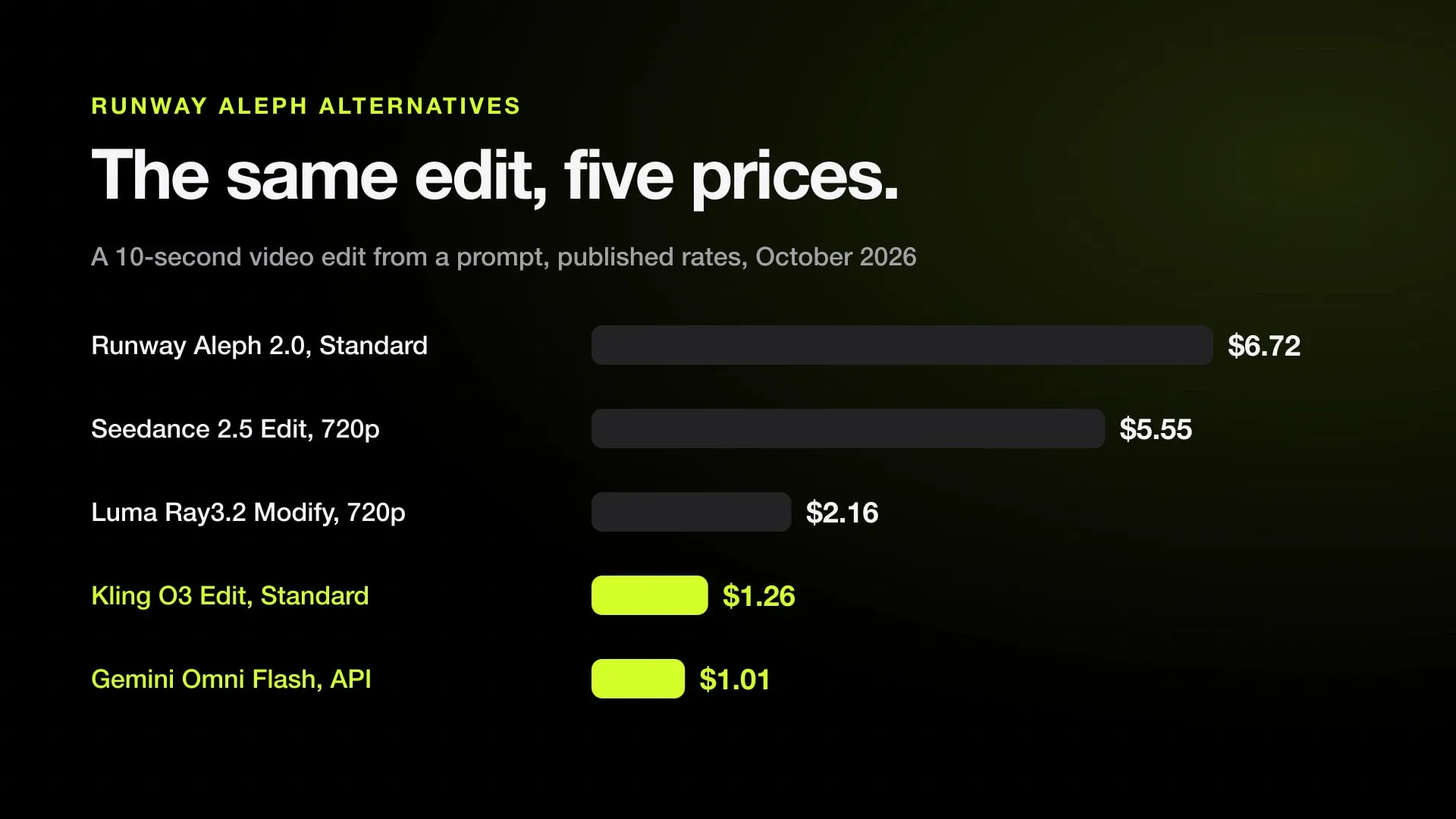
- A 10-second Aleph 2.0 edit is 280 Runway credits: $6.72 on the Standard plan, $2.24 on Max billed yearly and $2.80 through the API.
- The same 10-second edit costs about $1.26 with Kling O3 Edit on fal, $2.16 with Luma Ray3.2 Modify at 720p and about $1.01 plus input tokens with Gemini Omni Flash through the Gemini API.
- Seedance 2.5 Edit bills the input and the output seconds, so editing 10 seconds into 10 seconds at 720p is 20 billed seconds: $5.55 on fal or the Higgsfield API, $4.50 through Runway's API.
- Act-Two costs 5 credits a second, $1.20 for 10 seconds on Standard; Kling 3.0 Motion Control is $1.36 on Kling's Standard plan and $0.63 on Higgsfield's API with its current discount.
A 10-second Runway Aleph 2.0 edit costs $6.72 on the Standard plan. The cheapest alternatives for the same job, editing an existing clip from a prompt, are Kling O3 Edit at about $1.26 and Gemini Omni Flash at about $1.01. For Act-Two’s job, putting a performance onto a character, Kling 3.0 Motion Control does it from about $0.63.
Runway sells two different tools under these names, and the alternatives differ for each. Aleph edits a video you already have: remove a logo, relight a shot, restyle it, swap a product. Act-Two is motion capture: a driving performance video moves a character image. This page covers both, with each vendor’s published rates checked on October 25, 2026 and worked out for 10 seconds of video. Where a vendor does not publish a rate, the table says so.
The short answer
| Tool | Job | 10-second price | Longest clip | Where it runs |
|---|---|---|---|---|
| Runway Aleph 2.0 | Edit by prompt | $6.72 on Standard, $2.80 by API | 30 s at 1080p | Web, paid plans only |
| Kling O3 Edit | Edit by prompt | About $1.26 on fal (Standard), $1.68 (Pro) | 10 s input | Web, API, Higgsfield, Jutsu Studio |
| Seedance 2.5 Edit | Edit by prompt and references | $5.55 at 720p on fal or Higgsfield; $2.47 at 480p on Higgsfield | 30 s | API, Higgsfield, Jutsu Studio |
| Luma Ray3.2 Modify | Edit by prompt | $2.16 at 720p, $4.32 at 1080p | Not stated for Ray3.2 | Web, API |
| Gemini Omni Flash | Edit by prompt | About $1.01 plus input tokens by API | 10 s on Runway’s API | Gemini app, Flow, API |
| Higgsfield Genjutsu | Restyle, object swap | $6.81 at 720p by API, $3.41 with the current discount | 30 s | Web, API, Jutsu Studio |
| Runway Act-Two | Performance to character | $1.20 on Standard, $0.50 by API | Not stated by Runway | Web, API |
| Kling 3.0 Motion Control | Performance to character | $1.36 on Kling Standard; $0.63 on Higgsfield’s API now | 3–30 s driving video | Web, API, Higgsfield, Jutsu Studio |
| Hedra | Motion transfer, lip-sync | From $0.70 by API | Not stated | Web, API |
| Wan 2.1 VACE, Wan 2.2 Animate, SCAIL-2 | Edit; motion; replacement | $0 plus your GPU | Model limits | Your NVIDIA GPU, ComfyUI |
How each figure is worked out follows.
What Runway charges
Aleph 2.0 came out on May 21, 2026, with Runway’s Edit Studio. It edits clips up to 30 seconds at 1080p, and Runway’s announcement lists removing objects, changing the light or time of day, restyling, swapping a product and multi-shot edits, with one edited frame carried through the clip. It is on all paid plans, in the web app only.
It costs 28 credits a second, so 10 seconds is 280 credits. What that is in dollars depends on the plan:
| Runway plan | Price | Credits a month | 10-second Aleph 2.0 edit |
|---|---|---|---|
| Standard | $15, or $12 billed yearly | 625 | $6.72, or $5.38 |
| Pro | $35, or $28 billed yearly | 2,250 | $4.36, or $3.48 |
| Max | $95, or $76 billed yearly | 9,500 | $2.80, or $2.24 |
| API | $0.01 per credit | Prepaid | $2.80 (56-credit minimum) |
The plan formerly called Unlimited is now Max. The free plan’s 125 credits are a one-time grant and don’t cover one 10-second Aleph edit; Aleph isn’t on the free plan anyway. The older Gen-4 Aleph, from July 2025, costs 15 credits a second but works on 5-second clips, and it is no longer on the API price list.
Act-Two costs 5 credits a second with a 3-second minimum: $1.20 for 10 seconds on Standard, $0.50 through the API. It takes a driving performance and a character image or video and transfers face and body motion; the gesture option that moves hands and arms only works with a character image.
Alternatives for editing a video (Aleph)
Kling O3 Edit
Kling’s Omni models edit an existing clip from a prompt with up to four reference images: add, remove or swap objects, change the background, the camera angle or the style. Higgsfield’s documentation gives the input as 3–10 seconds. On fal, O3 Edit costs $0.126 a second on Standard and $0.168 on Pro, so $1.26 or $1.68 for 10 seconds; a 4K tier is $0.42 a second. Higgsfield’s API gives $0.126 a second as the top of its range and lists it from $0.063.
Kling 4.0 arrived in October with an edit mode that takes clips up to 30 seconds. Higgsfield lists it at $0.0658–$0.0987 a second, but its limits were still settling when this was written, so it is left out of the table.
Seedance 2.5 Edit and Extend
ByteDance’s Seedance 2.5 edits or extends a clip with reference images, which helps keep a character’s face and clothes the same from shot to shot. It bills differently from the others: the input seconds count as well as the output. Editing 10 seconds into 10 seconds is 20 billed seconds. At 720p that is $5.55 on both fal and the Higgsfield API, and $4.50 through Runway’s API, which also hosts Seedance 2.5. At 480p on Higgsfield it is $2.47. Clips run 4–30 seconds. More on the model is in the Seedance 2.5 guide.
Luma Ray3.2 Modify
Luma’s Modify takes a clip and a prompt, with modes that range from staying close to the source to reimagining it. In the app it costs 72 credits a second at 720p and 144 at 1080p. The Plus plan is $30 a month for 10,000 credits, so 10 seconds is $2.16 at 720p and $4.32 at 1080p; Luma’s API charges the same. There is no free plan.
Gemini Omni Flash
Google’s Gemini Omni Flash, launched on May 20, 2026, edits an uploaded video from a prompt: add objects or characters, change the setting, the style or the camera angle, one prompt after another. It is in the Gemini app and Flow for Google AI Plus, Pro and Ultra subscribers, and every output carries Google’s SynthID watermark. Through the Gemini API, 720p output is about $0.10 a second, about $1.01 for 10 seconds plus input tokens; Runway’s API sells it at 11 credits a second, capped at 10 seconds.
Higgsfield Genjutsu
Genjutsu, launched on August 31, 2026, restyles a video, swaps an object in it or transfers its motion to a character, from one video of 4–30 seconds and up to 30 reference images. Through Higgsfield’s API it lists at $0.681 a second at 720p, $6.81 for 10 seconds, or $3.18 at 480p; on October 25 Higgsfield showed both at half price, $3.41 and $1.59. On a Higgsfield plan, a 15-second clip at 720p is 104 credits, about $5.20. Genjutsu Lite, released on October 20, does motion transfer and object swap but not restyle, at $0.10 a second at 720p; it bills the source seconds as well as the output, so 10 seconds is $2.00 at list price. How Genjutsu works is in Higgsfield Genjutsu.
Open models
- Wan 2.1 VACE (Apache 2.0) does reference-to-video and masked video-to-video editing: draw over what should change and prompt it. The 14B model renders 480p or 720p and wants a large NVIDIA GPU.
- LTX-2.x from Lightricks regenerates a time range of an existing clip and does video-to-video with IC-LoRAs. It installs on macOS, but the full download is about 66 GB, and its licence requires a paid licence for companies with $10 million or more in annual revenue.
Wan 3.0 has no open weights; it is hosted only.
Alternatives for performance and motion (Act-Two)
Kling Motion Control
Kling 3.0 Motion Control puts the motion of a 3–30 second reference video onto a character image. On Kling’s Standard plan, 10 seconds is 90 credits, about $1.36. Kling’s own API charges $0.126 a second at 720p, $1.26 for 10 seconds. Higgsfield’s API has the same list price and showed it at half, $0.063, on October 25: $0.63 for 10 seconds. Runway’s API sells it at $1.30. The comparison with Higgsfield’s own tool is in Kling Motion Control vs Genjutsu.
Hedra
Hedra’s API lists editing and motion transfer from 7 cents a second, about $0.70 for 10 seconds, and avatar and lip-sync work from 2.5 cents. Its app plans weren’t readable without signing in, so they are left out.
Open models
- Wan 2.2 Animate (Apache 2.0, September 2025) makes a character image copy a video’s motion, or replaces the person in the video. Wan2.2-Animate-2-14B, released on August 7, 2026, reads the driving video directly without pose extraction.
- SCAIL-2 (Apache 2.0 code, MIT weights, June 2026) animates or replaces characters at 512p or 704p, with native ComfyUI support.
- LivePortrait moves a portrait’s face only. It runs on Apple silicon for human faces; its code is MIT, but the face detector it ships with is for non-commercial use.
All of them want an NVIDIA GPU for real work. What runs on a Mac is in Wan 2.2 on a Mac.
Jutsu Studio, on a Mac
Jutsu Studio is a free, open-source (MIT) Mac app for Higgsfield, from the makers of this site. It brings several of the tools above into one native window: Kling O3 Edit, Seedance 2.5 Edit and Extend, Genjutsu restyle, object swap and motion transfer, and Kling 3.0 Motion Control. You connect your Higgsfield account and spend your plan’s credits, or use your own API key and pay Higgsfield’s per-second rates. There is no backend of ours: the app talks to Higgsfield directly, and every result is saved to ~/Movies/Jutsu Studio/Videos on your disk.
A typical edit starts as a 480p draft, the cheapest way to check that a prompt works, before the same job runs at 720p or 1080p. The app runs on macOS 14 or later, on Apple silicon and Intel.
What Jutsu Studio does not do
- It doesn’t run Runway’s, Luma’s or Google’s models. Aleph, Act-Two, Ray3.2 and Omni Flash stay in their own apps.
- The rendering happens on Higgsfield’s servers, not on your Mac, so it needs a Higgsfield plan or API balance.
- There is no timeline or multi-shot editor like Runway’s Edit Studio; it makes and edits clips, and you cut them elsewhere.
- It is Mac only. There is no web, Windows or phone version yet.
Which to pick
- Edits by prompt, lowest price: Kling O3 Edit, about $1.26 for 10 seconds, or Gemini Omni Flash through the API.
- Keep a character consistent across shots: Seedance 2.5 Edit, paying for input and output seconds.
- Long clips edited in one pass, already on Runway: Aleph 2.0, cheapest on the Max plan or the API.
- Performance capture onto a character: Kling 3.0 Motion Control, or Act-Two if you already have Runway credits.
- Free, with your own NVIDIA GPU: Wan 2.1 VACE for edits, Wan 2.2 Animate or SCAIL-2 for motion.
- A Mac app with Kling, Seedance and Genjutsu edits and files on your disk: Jutsu Studio.
If the job is replacing the person in a video rather than editing the scene, see Viggle alternatives and how to swap a character in a video.
Sources
- Runway: pricing (checked October 25, 2026)
- Runway Academy: models and pricing
- Runway API: pricing
- Runway: introducing Aleph 2.0 and Edit Studio (May 21, 2026)
- Runway Research: introducing Runway Aleph (July 25, 2025)
- Runway Academy: Act-Two
- fal: Kling O3 Standard video-to-video edit
- fal: Kling O3 Pro video-to-video edit
- Higgsfield docs: Kling Omni video edit
- Higgsfield API: Seedance 2.5 video edit
- fal: Seedance 2.5 reference-to-video
- Luma: pricing
- Luma API: pricing
- Gemini API: pricing
- Higgsfield blog: Genjutsu
- Higgsfield API: Genjutsu
- Hedra: pricing
- Wan2.1-VACE-14B on Hugging Face
- Wan2.2-Animate-14B on Hugging Face
- Wan2.2-Animate-2-14B on Hugging Face
- SCAIL-2 on GitHub
- LTX-2 on GitHub, and its licence
- LivePortrait on GitHub
- Jutsu Studio on GitHub
Run Higgsfield from your Mac.
Jutsu Studio is a free, open-source Mac app for Higgsfield: a queue, a local library and the price on every button.