Jutsu Studio
In short
- To lip sync an existing video, the open models are LatentSync (8 GB of VRAM for version 1.5, 18 GB for 1.6), MuseTalk 1.5 (30 fps or more on a Tesla V100) and InfiniteTalk, which also moves the head and body.
- To make a still photo talk from audio: SadTalker, Wan2.2-S2V-14B, HunyuanVideo-Avatar and InfiniteTalk's image-to-video mode. LivePortrait animates a photo from a driving video, not from audio.
- Wav2Lip's README says "any form of commercial use is strictly prohibited". MuseTalk says its model may be used for any purpose, even commercially. LatentSync and LivePortrait load InsightFace models, which InsightFace releases for non-commercial research only.
- LivePortrait officially supports Apple Silicon Macs but warns it may be 20 times slower than an RTX 4090. SadTalker was tested on an M1 Mac. LatentSync, MuseTalk, InfiniteTalk and HunyuanVideo-Avatar document NVIDIA GPUs only.
- Jutsu Studio is a free open-source Mac app for Higgsfield that runs Higgsfield's paid Dub and Change Voice on a finished result. That is a hosted option, not open weights.
Open-source lip sync splits into two jobs. One replaces the mouth in a video you already have so it matches new audio: that is dubbing, and the open models for it are LatentSync, MuseTalk, InfiniteTalk and the older Wav2Lip. The other takes a single photo and an audio track and makes a talking head: SadTalker, Wan2.2-S2V, HunyuanVideo-Avatar and InfiniteTalk’s image mode. LivePortrait, often listed with them, animates a photo from a driving video rather than from audio.
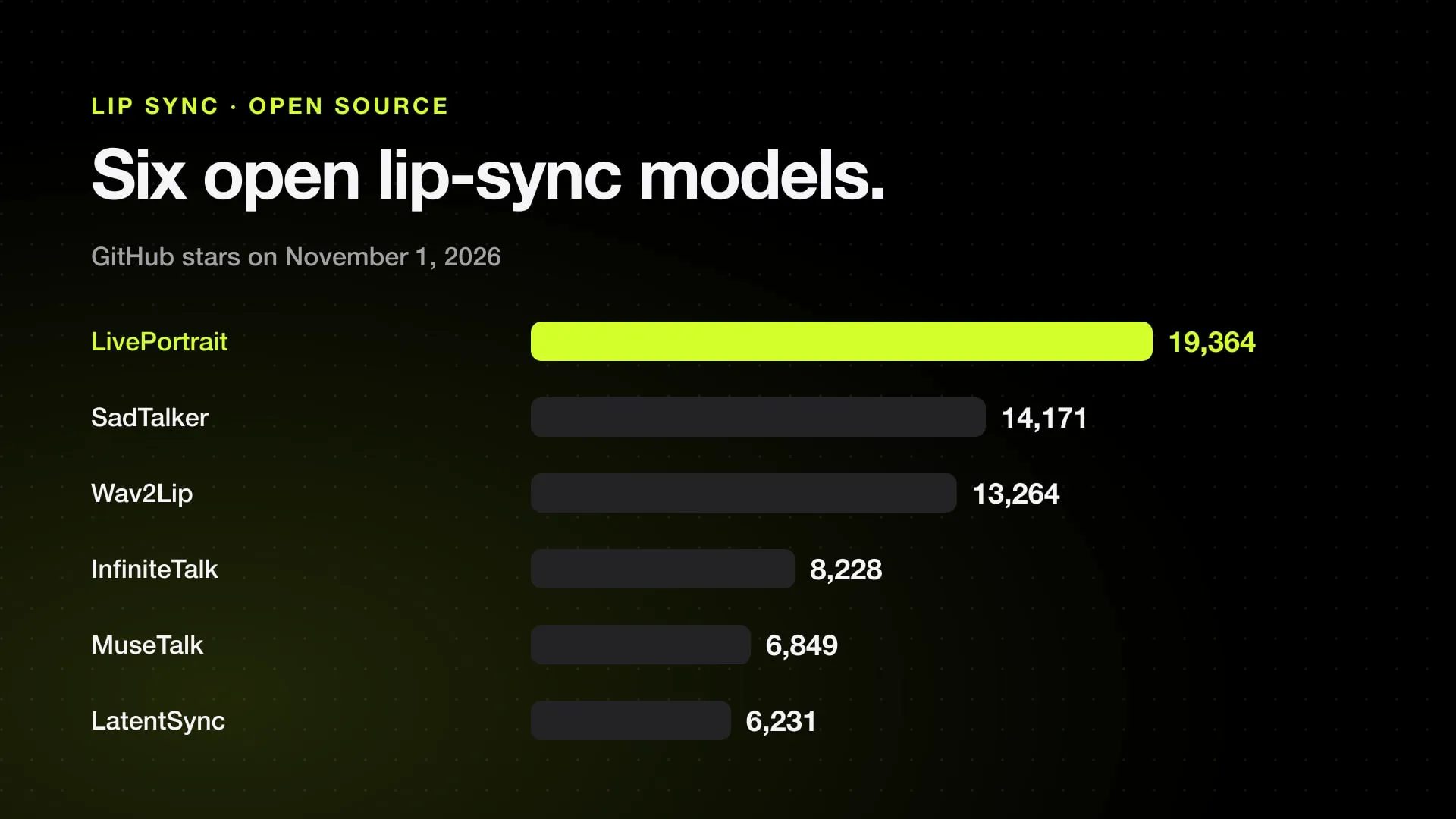
Every figure below comes from each project’s own README, license file or Hugging Face model card, checked on November 1, 2026. Star counts are from the GitHub API on the same day. Where a project doesn’t publish a number, the table says so.
The short answer
- Dub an existing video, commercial use allowed: MuseTalk 1.5, whose README says the model is “available for any purpose, even commercially”.
- Dub an existing video, sharpest mouth from the open models: LatentSync 1.6, trained on 512×512 video, on an NVIDIA GPU with 18 GB or more. Check the InsightFace terms below before commercial use.
- Dub with head and body motion, long clips: InfiniteTalk, Apache 2.0, built on Wan 2.1.
- Make a photo talk on modest hardware or a Mac: SadTalker, Apache 2.0, tested on an M1 Mac.
- Make a photo talk at 720p on a big GPU: Wan2.2-S2V-14B, Apache 2.0.
- Not for commercial work: Wav2Lip, whose README prohibits it.
Comparison table
| Model | Input | Code / weights license | Output | VRAM (from the README) | Mac | ComfyUI | Stars | Last code push |
|---|---|---|---|---|---|---|---|---|
| LatentSync 1.5 / 1.6 | Video + audio | Apache 2.0 / OpenRAIL++ | 256×256 face (1.5), 512×512 (1.6) | 8 GB (1.5), 18 GB (1.6) | Not supported (CUDA pinned) | Community node | 6,231 | June 20, 2025 |
| MuseTalk 1.5 | Video + audio | MIT / MIT, commercial use allowed | 256×256 face region | Ran on a 4 GB laptop GPU in fp16 | Not mentioned | Community node | 6,849 | September 26, 2025 |
| InfiniteTalk | Video + audio, or image + audio | Apache 2.0 / Apache 2.0 | 480p or 720p | Low-VRAM mode, no figure given | Not mentioned | Kijai’s WanVideoWrapper | 8,228 | May 22, 2026 |
| Wav2Lip | Video + audio | No license file; README: non-commercial only | Low-resolution face | Not published | Not mentioned | Community node | 13,264 | June 22, 2025 |
| SadTalker | Image + audio | Apache 2.0 except third-party parts / MIT tag | 256 or 512 face model | Not published | Tested on an M1 Mac | Not official | 14,171 | June 26, 2024 |
| Wan2.2-S2V-14B | Image + audio (+ optional pose video) | Apache 2.0 / Apache 2.0 | 480p or 720p | 80 GB for the single-GPU command | Not official | Yes | 18,300 (Wan2.2 repo) | September 21, 2026 |
| HunyuanVideo-Avatar | Image + audio | Tencent Hunyuan Community License | 704 px example | 24 GB minimum, 96 GB recommended; 10 GB through Wan2GP | NVIDIA required | Planned, not released | 2,195 | December 16, 2025 |
| LivePortrait | Image or video + driving video (no audio) | MIT / MIT | Portrait video | Not published | Official, Apple Silicon | Several community nodes | 19,364 | June 1, 2026 |
The models
LatentSync
ByteDance’s LatentSync is an audio-conditioned latent diffusion model for lip sync, without an intermediate motion step. Version 1.5 (March 14, 2025) added temporal layers for steadier output and better results on Chinese video. Version 1.6 (June 11, 2025) was trained on 512×512 video because, in the model card’s words, many people reported that version 1.5’s teeth and lips were blurry; the architecture is the same, so one codebase loads either checkpoint.
The README lists minimum inference VRAM as 8 GB for 1.5 and 18 GB for 1.6. The code is Apache 2.0 and the Hugging Face weights are tagged OpenRAIL++. Its face detector imports InsightFace and runs it on CUDA, which matters for both commercial use and Macs (see below). A community ComfyUI wrapper, ComfyUI-LatentSyncWrapper, has 962 stars and no license file.
MuseTalk
Tencent Music’s MuseTalk edits the face of an existing video in the latent space of Stable Diffusion’s ft-mse VAE. It works on a 256×256 face region and the README claims 30 fps or more on an NVIDIA Tesla V100, which is why it is used for real-time avatars. Version 1.5 (March 28, 2025) improved clarity, identity and sync, and the training code followed on April 5, 2025.
The low end is documented too: on an RTX 3050 Ti laptop GPU with 4 GB, an 8-second video took about 5 minutes in fp16. Input video should be 25 fps, the rate it was trained on. The README suggests a face restorer such as GFPGAN if 256×256 is not sharp enough. Its README links a community ComfyUI node, ComfyUI-MuseTalk.
InfiniteTalk
MeiGen-AI’s InfiniteTalk (August 19, 2025) calls itself a “sparse-frame video dubbing” model. Given a video and an audio track, it regenerates the clip so that lips, head, body and expressions follow the new speech, and it also takes a single image. It is built on Wan2.1-I2V-14B-480P, renders at 480p or 720p, and the default maximum is 40 seconds (1,000 frames), with longer runs possible. The README notes that image-to-video holds up to about a minute before colors start to shift. Models are Apache 2.0, with ComfyUI support through Kijai’s ComfyUI-WanVideoWrapper and a low-VRAM path through Wan2GP. The same team released LongCat-Video-Avatar 1.5 on May 21, 2026.
Wav2Lip
Wav2Lip, from the ACM Multimedia 2020 paper “A Lip Sync Expert Is All You Need”, is the model most older lip sync tools were built on. Its README now opens with an ad for the authors’ commercial API at sync.so and says that version is “of a much higher quality than the old open source model”. The open model was trained on low-resolution faces, and the README suggests --resize_factor because 720p input can look better than 1080p. There is no license file, and the README restricts it to personal, research and non-commercial use.
SadTalker
SadTalker (CVPR 2023) turns one image and an audio track into a talking head by predicting 3D motion coefficients. It ships 256 and 512 face models, a --still mode for full-body photos and an optional GFPGAN enhancer, plus a Gradio app and a Stable Diffusion WebUI extension. The license was changed to Apache 2.0 with the non-commercial restriction removed, except for listed third-party components. The last code push was June 26, 2024, so treat it as finished rather than maintained.
Wan2.2-S2V-14B
Alibaba’s Wan2.2-S2V-14B (August 26, 2025) is an audio-driven video model: a reference image, an audio track and an optional prompt, with an optional pose video to control the body. It renders 480p or 720p and the clip length follows the audio. The single-GPU command needs 80 GB of VRAM. Code and weights are Apache 2.0, ComfyUI integration is done, and CosyVoice text-to-speech was added on September 5, 2025. Running Wan models on a Mac is covered in Wan 2.2 on a Mac.
HunyuanVideo-Avatar
Tencent’s HunyuanVideo-Avatar (May 28, 2025) animates one or several characters in an image from audio, with emotion control. The README requires an NVIDIA GPU with CUDA: 24 GB minimum for 704 px video (“but very slow”) and 96 GB recommended; a 10 GB single-GPU mode exists through Wan2GP. ComfyUI is still an unchecked item on its to-do list. The license is not open source in the usual sense: the Tencent Hunyuan Community License doesn’t apply in the European Union, the United Kingdom or South Korea, and services with more than 100 million monthly users must ask Tencent for a license.
LivePortrait
LivePortrait, from Kuaishou’s Kling team (the repository now lives under KlingAIResearch), is the most-starred project here at 19,364. It is not audio-driven: it moves a portrait’s face and head to follow a driving video or a saved motion template, and has an Animals mode for cats and dogs. Code and weights are MIT. Pair it with an audio model, or film yourself saying the line, if you need speech. It officially supports Apple Silicon Macs; more in the Mac section.
Dubbing a video vs animating a photo
The two jobs need different models, and mixing them up is the most common reason a result looks wrong.
Dubbing keeps the original performance: the body, the camera, the lighting and the background stay, and only the mouth area changes to match a translated or rewritten line. LatentSync, MuseTalk and Wav2Lip do this. They need a clip where the face is visible and roughly frontal, and the rest of the frame passes through untouched. InfiniteTalk sits between the two jobs: it starts from your video but regenerates more of it, so head nods and gestures follow the new audio too, at the cost of a full 14B video model and some drift from the original camera move, which its README acknowledges.
Animating a photo invents all the motion from one frame. SadTalker does it cheaply with a 3D face model; Wan2.2-S2V and HunyuanVideo-Avatar generate a whole video with a 14B-class diffusion model and can move hands and bodies, but need datacenter memory in their official commands. LivePortrait animates a photo too, from a driving video rather than audio.
Only dub people who agreed to it, and say a video is dubbed or synthetic where the platform or the law asks you to.
Commercial-use licenses
The code license is only part of the answer. Check three layers: code, model weights, and the face detectors or other models the code downloads.
- Commercial use allowed by the project: MuseTalk (MIT code; “the trained model are available for any purpose, even commercially”, with its dependencies such as Whisper, DWPose and S3FD under their own licenses and its test data non-commercial), InfiniteTalk (Apache 2.0 models), Wan2.2-S2V (Apache 2.0), SadTalker (Apache 2.0 apart from third-party parts), LivePortrait (MIT).
- Watch the InsightFace dependency: LatentSync’s face detector and LivePortrait’s face cropping use InsightFace. InsightFace’s code is MIT, but its README says its pretrained models are for “non-commercial research purposes only”. For LivePortrait, Kijai’s ComfyUI-LivePortraitKJ node offers MediaPipe instead of InsightFace. For LatentSync, the weights also carry OpenRAIL++ use restrictions.
- Conditional: HunyuanVideo-Avatar, under a license that excludes the EU, UK and South Korea and caps very large services.
- Not for commercial use: Wav2Lip, trained on LRS2: “any form of commercial use is strictly prohibited”.
None of this is legal advice; read the license files of the exact versions you download.
Running on a Mac
Most of these projects are written for NVIDIA GPUs:
- LivePortrait has supported macOS on Apple Silicon since July 17, 2024, with its own
requirements_macOS.txtandPYTORCH_ENABLE_MPS_FALLBACK=1. The README warns it “maybe 20x slower than RTX 4090”, Animals mode doesn’t work on a Mac, and Intel Macs are not supported. - SadTalker has macOS install steps that were tested on an M1 Mac running macOS 13.3, and its WebUI script starts on Linux and macOS.
- LatentSync pins a CUDA build of PyTorch and onnxruntime-gpu, and runs InsightFace on the CUDA provider. It won’t run on a Mac without changes.
- MuseTalk, InfiniteTalk and Wav2Lip don’t mention macOS; MuseTalk’s install steps cover Linux and Windows.
- HunyuanVideo-Avatar says an NVIDIA GPU with CUDA is required.
- Wan2.2-S2V has no official Mac path. Wan models load in ComfyUI on Apple Silicon, slowly; see ComfyUI on a Mac for what MPS can and can’t do.
For other local video options, see local AI video generators for Mac and Pinokio for AI video.
Lip sync in ComfyUI
- Wan2.2-S2V: ComfyUI integration is ticked off in the Wan2.2 README.
- InfiniteTalk: through Kijai’s ComfyUI-WanVideoWrapper, Apache 2.0, which InfiniteTalk’s README lists as its ComfyUI route.
- LatentSync: ComfyUI-LatentSyncWrapper, community-made.
- MuseTalk: ComfyUI-MuseTalk, linked from MuseTalk’s README; last updated in May 2024.
- LivePortrait: ComfyUI-AdvancedLivePortrait and ComfyUI-LivePortraitKJ, both listed in LivePortrait’s README.
- Wav2Lip: ComfyUI_wav2lip, community-made, under Wav2Lip’s non-commercial terms.
A node doesn’t change the license of the model it loads. On a Mac, nodes that depend on CUDA-only packages fail the same way the original code does.
A hosted option on a Mac
If you don’t have an NVIDIA GPU and the result is already a Higgsfield video, there is a hosted route. Jutsu Studio is a free open-source Mac app for Higgsfield that runs Higgsfield’s paid Dub and Change Voice on a finished result through your Higgsfield account. The app is open source; the dubbing model is not. It runs on Higgsfield’s servers and is billed to your account, so it is not an open-weights alternative to the models above. Other Mac apps for AI video are compared in the best AI video apps for Mac, and Viggle-style tools, including LivePortrait, in Viggle alternatives.
Which to pick
- Commercial dubbing on your own GPU: MuseTalk 1.5.
- Sharpest open dub with 18 GB or more: LatentSync 1.6, after checking InsightFace’s terms.
- Dubbing that also moves the head and body: InfiniteTalk.
- A talking photo on a Mac: SadTalker; LivePortrait if you can drive it with a video.
- A talking photo at 720p with a large NVIDIA GPU: Wan2.2-S2V-14B.
- Research and personal tests only: Wav2Lip.
Sources
- bytedance/LatentSync on GitHub (checked November 1, 2026)
- ByteDance/LatentSync-1.6 on Hugging Face (checked November 1, 2026)
- TMElyralab/MuseTalk on GitHub (checked November 1, 2026)
- KlingAIResearch/LivePortrait on GitHub (checked November 1, 2026)
- Rudrabha/Wav2Lip on GitHub (checked November 1, 2026)
- OpenTalker/SadTalker on GitHub (checked November 1, 2026)
- MeiGen-AI/InfiniteTalk on GitHub (checked November 1, 2026)
- Wan-Video/Wan2.2 on GitHub, Speech-to-Video section (checked November 1, 2026)
- Wan-AI/Wan2.2-S2V-14B on Hugging Face (checked November 1, 2026)
- Tencent-Hunyuan/HunyuanVideo-Avatar on GitHub (checked November 1, 2026)
- deepinsight/insightface on GitHub, license section (checked November 1, 2026)
- kijai/ComfyUI-WanVideoWrapper on GitHub (checked November 1, 2026)
- ShmuelRonen/ComfyUI-LatentSyncWrapper on GitHub (checked November 1, 2026)
Run Higgsfield from your Mac.
Jutsu Studio is a free, open-source Higgsfield desktop app for Mac: a queue, a local library and the price on every button.